Jose's India Travel Newsletter
K A S H M I R

 Introduction Delhi Leh/Ladakh Kashmir
Kashmir Section 1 Kashmir: Section 1 I Section 2 I Section 3 I Section 4 I Section 5
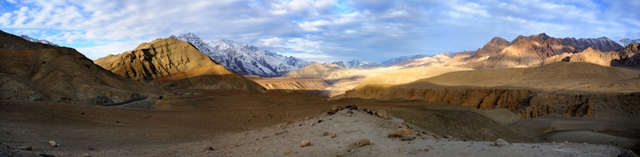
Road to Kashmir from Leh Ladakh
I must say that at first I was afraid to come to Kashmir. The embassy has a huge travel warning about the area. The news reports have said that militants and terrorists are everywhere and ready to strike while the Indian army is on high alert. In addition to hearing stories that the army is on guard everywhere and barbed wire was around many hotels and other public places, I heard that the famous Dal Lake was polluted and that you couldn’t even see the mountains. Furthermore, I heard that the people were not very nice like the Ladakhis and that the Kashmiris were very pushy; always trying to sell you something. Someone also told me that on Dal Lake people renting a house boat are at the mercy of house boat owners because the only way to get off of the house boat and back to land is by boat. And, if the house boat owner doesn’t provide a boat, the renter is stuck on the boat. In one case, some people were abandoned without their passport and left on the houseboat for three days. Another person told me that some locals pulled out a shot gun and killed a duck right in front of some tourists while staying on a house boat and that really scared them.
Some of the scenes along the way to Kashmir are void of vegetation but stunning beautiful
I met a couple of good friends in Leh, Shabir and Hanna. Shabir is Kashmiri and Hanna is the English teacher from Switzerland at Thiksey monastery; Shabir is Hanna’s boyfriend. So, I asked Shabir about the news I heard and he said, ”it fine, Joss”, for some reason he and Hanna call me Joss, I think they just can’t pronounce my name. He said that the news people sensationalize everything in order to sell more news media and that many of these stories, in his opinion, were exaggerated.
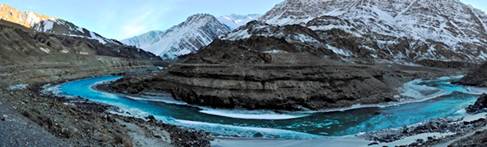
The Indus and Zanskar rivers of the Indus ValleyAnyhow, I tried to talk to as many people as I could that have been to Kashmir recently. There were many who told me how beautiful and great it was. One day at the hotel in Leh, I met a group of ladies that had just come from Kashmir. They told they had a fabulous time. They swam in the lake and traveled all over the area. I figured the truth lay somewhere in between all these stories. So my gut feeling was with the ladies, and I trusted Shabir, “I’m going!”
Hanna, Shabir, five other locals and I headed out to Srinagar, Kashmir in the late afternoon in a shared jeep. At this point, Shabir, Hanna and I had become very good friends and they were now my new travel buddies.
It is an overnight trip and you are suppose to get there mid-morning. This is only guaranteed if the Zojil La pass, which is over 5,000 meters (16,250 feet) high, is open and everything else goes smooth…anything can happen on this road. Before leaving, we were worried about the road conditions because it snowed in Leh. And, it had been very cold, below 0 degrees Celsius (32 degrees Fahrenheit), with no heaters in the rooms-- yes, it was time to leave Leh. Hanna and I were some of the last foreigners left.
It’s only about 495 kilometers (293 miles) to Srinagar but it takes 14 to 18 hours to get there. To put this in perspective on how tough the road is, at best you average 35 kilometers (21 miles) per hour. It was 22th of October when we left for Srinagar, (three days after my birthday, please don’t forget, that’s the 19th of Oct to make it easy for you all) and the roads will be closing soon for the winter; we’re at the mercy of Mother Nature and her mood.
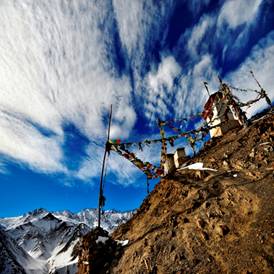
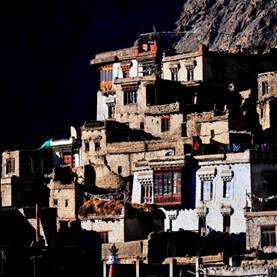
Prayer flags along the road to Kashmir Last Buddhist village of Lamayuru before entering Muslim KashmirThe drivers are truly amazing, they can drive all night to Srinagar; again on a road that is extremely rough and non-forgiving (if you make a mistake, you’re at the bottom of a deep canyon). There are blind spots at just about every turn, most of the road is a one- lane road and, to top it off, most of the driving was at night. It was best not to even think about. Fortunately, this driver was very cautious and did not drive like a bat out hell. Plus, the drivers own their vehicle which means they take better care of them and it is much safer versus public transportation. And, this particular driver had an older Toyota which was quite comfortable and you didn’t bounce around very much.
Big tip: Check to see if the driver is willing to stop for smoke breaks, if not; you’ll end up in a vehicle with the windows rolled down and the cold coming in every time a smoker lights up…we had five smokers. And, it’s always best to check out the vehicle a day before to make sure that is in fairly good condition and that the tires have some tread left on them.
We were supposed to stop in Dras at 2:00am and wait for a few hours until traffic going westward to Srinagar had priority over east bound traffic, this happens at about 4:00am but we didn’t stop there. By the way, Dras is the second coldest inhabitable place on the planet besides Siberia…lucky for us it’s only October. About two hours before reaching Dras, we stopped in Kargil. The driver had been bitten by an insect along the way; probably while smoking and with the window rolled down. The bite was right below his eye and it swelled up so big that he could not see out of it. All the locals took a look at the eye to confirm that he had really gotten bit. After confirming the severity of the eye, the locals took the driver to the doctor; I don’t know where they found a doctor at midnight.
Hanna and I stayed in the jeep waiting for them to return. We waited and waited but they just did not come; the bad thing was that they had taken all the blankets. Thank God that we were wearing most of the clothes we owned, five layers plus heavy jackets, scarves, and yak wool caps. Hanna shared her Yak shawl with me and I shared my bottle of J&K, a cheap bootleg rum. J&K stands for the state of” Jammu and Kashmir”, it’s considered one state and Ladakh is a province of J&K.
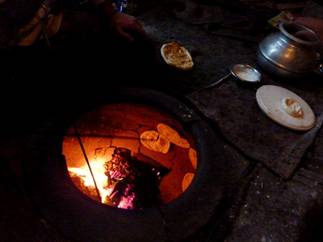
It was pretty cold but bearable, the J&K helped. In the early morning the sun came up and it felt so good. We went out looking for some chai (hot tea with milk) but there were no restaurants or stores opened. We did manage to find a baker that was baking fresh Kashmiri style bread. It was so nice to be next to the hot oven and the fresh bread was crispy on the outside and soft in the inside. Well, I know that sounds like a commercial, but there is a heaven at every corner.
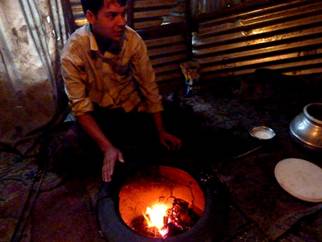
Fresh baked Kashmir bread, “So Good” especially when it’s freezingEveryone finally came back about 6am and the driver’s eye was much better; I was glad they decided to wait until the morning to continue our trip because his eye was still pretty bad. We headed out to Srinagar, via Dras and the mountain village of Sonamarg.
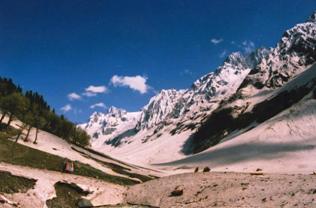
On the plus side, it was nice that we waited till the morning because we had heard that the area around the mountain village of Sonamarg was beautiful. I could tell that the driver had stepped it up a bit on the road. We came into Sonamarg and had breakfast. There was fresh new snow and still a bit of green left in the lower valleys. Shabir told us that here were two other very scenic areas like Sonamarg. Gulmarg, which has a ski area, is about 50 kilometers (31 miles) west of Srinagar and Pahalgam is about 90 kilometers (56 miles) to the south.
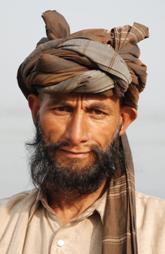
”Gujjar” herdsmanIn the hill in from of the restaurant we noticed there were hundreds of people out horseback riding. It had to be the Indian tourists. The horses were really cute tiny ponies. It looked odd because the ponies and the riders looked un-proportional; imagine a tiny pony carrying an adult person. Well, you had to be there, hundreds, mainly Indian tourists, riding these tiny ponies; too bad I didn’t get a photo.

Senery around Sonamarg Sonamarg Glacier
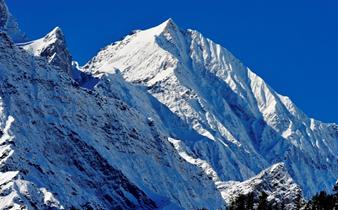
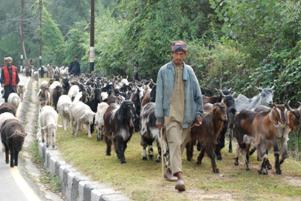
This peak near Sonamarg looks like the Matterhorn of SwitzerlandLiving throughout the mountains are the Nomad people. The Kashmiris call them Gujjar which means “Gypsies.” They mainly tend to their goats, make charcoal to sell and will come into the lower villages and into Srinagar before the winter sets in.
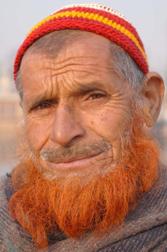
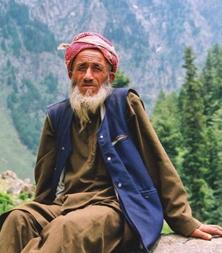
Nomad people around Sonamarg, also known as the “Gujjar”, Gypsies of Kashmir

Gypsy children with their goats Nomads coming to their villages for the winterAbout 40 kilometers (25 miles) from Srinagar we got a flat. It was funny because again everyone got out of the jeep to confirm that the tire was really flat, they looked at it, touched it and kicked the tire; their actions were similar to that when everyone looked at the driver’s eye. Just as everyone was looking at the tire, a huge truck came round the bend nearly hitting and pushing everyone and the jeep over. They just move aside and did seem to mind that as much as the flat tire. I was just up the hill taking the picture. After fixing the flat, we headed out again and the driver began to drive faster and faster as we got closer to Srinagar.
It was Friday and the locals in the jeep wanted to make it to the 2:00pm prayer at the mosque. The driver was now driving like a bat out of hell to make it on time. The road comes into Srinagar from the north and through the old city. Kashmir is 95% Muslim and when we were driving through the old city, there were thousands of people going to the mosque for prayer. The huge Jamia Masjid mosque holds about 33,000 people and on that day the mosque was full and there were people standing outside its gates; there were so many people. Hanna and I wondered what we had gotten ourselves into; Leh has a total of 20,000 people. For Shabir and the others, it was just another Friday prayer and very normal.
The trip from Leh to Srinagar only took 20 hours, but if you average that out, it's about 24 kilometers (15 miles) per hour. That’s not bad, it took my friend David, two days to cover about the same distance going from Leh to Manali; that road is even worse. It’s all an adventure!
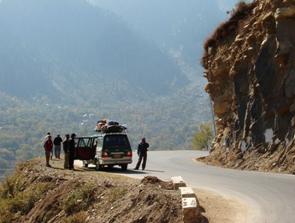

Flat tire inspection team at work Big truck, one lane, close call!
Dal Lake
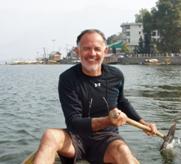
Nice and warm on Dal Lake,
in my boat called a “Shikara”Shabir works for Zanskar Arts. He travels between Leh and Goa following the high tourist seasons, summer in Leh and winter in Goa. The danger and instability brought about because of the militancy upraising in Kashmir, which began in 1989 and ended about a few years ago, caused a tremendous decline of business. Consequently, many Kashmiris have taken their shops and established businesses all over the country. Shabir sells jewelry, Kashmiri rugs, shawls, Ladakhi tankas and wood carvings to the tourists. That’s how I met Shabir, his shop in Leh. Anyhow, Shabir was going home before heading to Goa and asked Hanna and I to come. This was great because we would have someone who is local to show us around the town.
We finally got to the main boulevard, also known as the “boardwalk” on Dal Lake. Seleem, Shabir’s brother met us and shuttled us across the lake to one of the house boats owned by Ibrahim Thulla. There are about 1400 house boats on the lake and business has been very tough over the past 20 years…this is mainly because the militancy uprising has scared away many of the tourists.
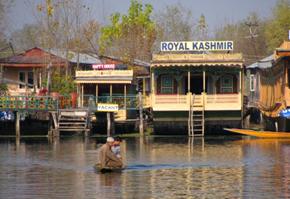
Ibrahim has two house boats, a large deluxe one called “Royal Kashmir" and a smaller one called “Happy House”. Everyone told us not to book a house boat outside of Kashmir and that is was best to come and see a few of them before choosing one. Then make the best deal possible. There are some good deals because they’re hurting for business.

Deluxe Royal Kashmir House Boat, 5x31 meters (15x95 feet)
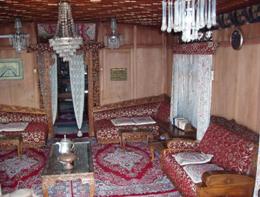
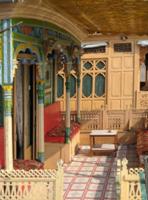
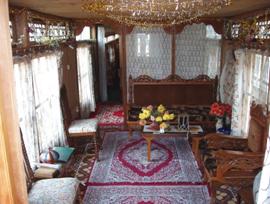
Living room of the Royal Kashmir Ibrahim and Irfan crossing to the main boulevard, “The Boardwalk”While the large deluxe house boat was very fancy, the smaller one was very cute and cozy. Well I’m sure you can guess which one we picked, “Happy House”. I took the back bedroom and Hanna and Shabir the one in the middle of the boat. The house boat has a living room, a dining room, and each of the bedrooms had their own bath room with a shower and plenty of HOT water.

Happy House, 3x25 meters (10x95feet) Living room of Happy House
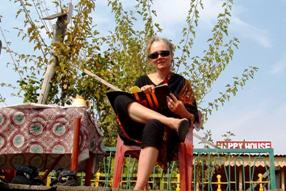

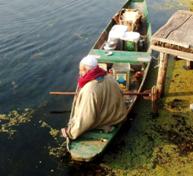
Hanna reading and having “Kahwa”, Kashmiri tea Breakfast on the deck, getting cold, mid NovemberEveryone and everything came by the houseboat throughout the day. Early in the morning, the milkman came by with fresh milk and yogurt from the village; I don’t think it was pasteurized. Then came the vegetable man, all organic stuff, the garbage people, the flower man, the baker, the snack man, the Kodak photographer, the laundry man, the tailor,(he actually came by four times to visit me to see if I wanted something made, I think he finally got it that I was not buying), the jewelry goldsmith, the floating souvenir store, the man who sold coal and wood for burning, a farmer even delivered a live sheep for the “Eid”, (Muslim festival equivalent to Christmas), the gas man selling propane gas, the travel agent, the postman, the cellular phone guy, the fisherman and more and more and more. So, during the day we just sat on the deck and enjoyed watching life come and go and whenever we wanted anything, it appeared.
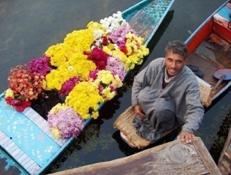
The flower man The milkman, fresh yogurt too Roses for Madame
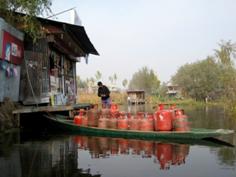
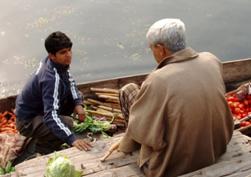
The propane gas man, for heating and cooking Ibrahim buying vegetables for diner
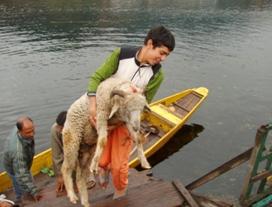
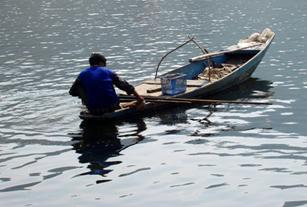
The farmer brings by a sheep for “Eid”, Irfan welcomes it on board Fisherman on the lake