Jose's India Travel Newsletter
K A S H M I R

 Introduction Delhi Leh/Ladakh Kashmir
Kashmir Section 4 Kashmir: Section 1 I Section 2 I Section 3 I Section 4 I Section 5
The Old City
I had my first introduction to Islam when I was working in Saudi Arabia back in the late 70’s and this experience left me with a negative view of Islam. That was certainly not the right place to learn about Islam. In Saudi, “The House of Saud”--basically the ruling king, princesses, sheiks and the top Islamic leaders--force people to follow the philosophy of an early 18th century Saudi religious leader, Abdul Wahab. This philosophy is better known as Wahabiism. Abdu Wahab wanted to return to the old ways of life during the time of the prophet Mohammed (SAW). However, Wahabiism is intolerant towards other religions, and infidels. Not only are they intolerant of other faiths, they have also put women in a so-called “protective state” and according to this “protective state” women are not equal to men and men dominate and dictate every aspect of a woman’s life. One other major part of this philosophy is that it does not allow any room for change. Everything must remain like it was back during the time of the prophet Mohammed (SAW).
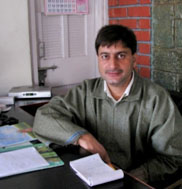
Rouf John, manager of the
Swiss Hotel in SrinagarSo… here I am in Kashmir and it is about 95% Muslim. One of my first conversations about Islam was with Rouf John, manager of the Swiss Hotel--by the way, this hotel is very nice and clean and it s located in a quiet area near the lake; it’s a bargain. Rouf is a Sufi and he was telling me about the way of the Sufis and how they were open to all religions. He said that Sufis follow the teachings of love, compassion and good will towards all of humanity. He said they had welcomed the many great religious men and women of all faiths that have come and blessed Kashmir over the past two thousand years; this includes the Buddhists, Hindus, Christians, Muslims and others. It is from Kashmir that Buddhism traveled to Ladakh, then to Tibet, on to mainland China and then to Korea and Japan.
I listened to Rouf, smiled politely but I knew better. I lived in Saudi and other Middle Eastern counties and my experiences there were the extreme opposite of what Rouf was saying. He was painting a pretty picture of Islam.
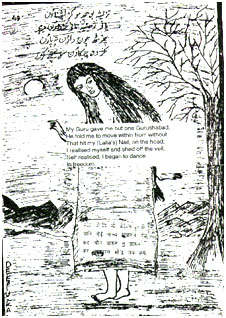
Poem by LalDed,
poet and mystic of KashmirMy Guru gave me but one Gurushabad;
He told me to move within from without.
That hit my Lalla’s (father’s) nail, on the head;
I realized myself and shed off the veil;
Self realized, I began to dance in freedom.
For more information on LalDed,
please go this website: http://www.koausa.org/saints/lalded/index.html
I left it at that, but Rouf lent me a book from the Rumi Foundation of Delhi on “The Way of the Sufis of Kashmir”. The book, or really a large magazine, was incredible. It talked about openness, about love, compassion and how Sufism is the essence of Islam and how Kashmir has played a great part in the mystical tradition of Sufism. But as incredible as the book seemed, even if the opening part of the book spoke about LalDed, “The Great Mother” and one of the great mystics of Sufism, and a woman at that; I had a very hard time reconciling my Saudi experiences of Islam with this totally new view. I did notice that the people here are extremely hospitable and gracious, I mean they are really incredible people…I asked myself, could this be because of the Kashmiri Islamic way of life? With all the Kashmiris I had met, no one has ever tried to impose their religion on me or even their views on their religion. I started to wonder whether the Kashmiris are truly following the openness and inclusiveness that the prophet Mohammed (SAW) preached about Islam and of all faiths that include love, compassion, and goodwill towards humanity in their teachings.
One day I wanted to go to the old city. I had just bought a new camera and I wanted to take some pictures. I asked Ibrahim, the houseboat owner where to start. He suggested that I start at Jamia Masjid Mosque and take the short cut to Shahi Hamdan Mosque. So I took the bus to Jamia Masjid Mosque like Ibrahim suggested and I walked directly to the mosque. This was not my first visit to Jamia Masjid; the last time I was here was with Shabir and Hanna and we were rushing from mosque to mosque. Shabir is also Muslim and he wanted us to see all the beautiful mosques in Srinagar. This time, I wanted to take my time and meditate or pray or just observe. By the way, both Hanna and Shabir had left Kashmir. Hanna went back to Thiksey monastery for a week to work with the boy monks on their Chams festival; maybe I will meet up with her in Dharamshala, for the teachings of the Dalai Lama. Shabir has left to Goa to run the shop. So now I have all the time in the world to explore this mosque and this neighborhood.
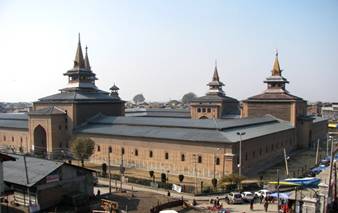
Jamia Masjid Mosque, over 33,000 people attend prayer services every FridayI walked into Jamia Masjid and it is huge. There are 33,000 people that come to the 2:00pm prayer every Friday. Inside there are 379 very large columns that hold the roof structure. It is said that the last column came directly from God but no one knows which one. So many people that come here hug each column to make sure they hug the one that came from God. The steeples on the roof top, for some reason, remind me of the church steeples back during the Salem witch trials in the USA during the late 1600s…or maybe the steeples just look like the witches' hats. At any rate, the mosques here are very different from any of the mosques I have seen throughout the Middle East and they do not have any minarets.
From the moment I walked into the mosque, I felt welcomed; maybe it was the smiles of the old men at the entrance. The mosque was really empty now, just a few of us but I could just imagine being here with 33,000 other people on a Friday. I had plenty of space to meditate, to pray the “Our Father”, or to just sit and observe. There was a man far up from me and he was praying all by himself. The scene was precious so I took a picture.
I was carrying my shoes because one needs to take off your shoes when you enter a mosque. I had placed them on the carpet. A while later, a young girl came up to me and indicated that I should place the soles of the shoes together and not on the carpet as a sign of respect. I told her that I was really sorry but I did not know. She just smiled and said in perfect English, “That’s ok and welcome to our home”.
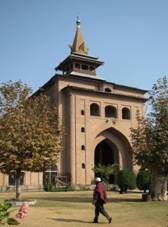
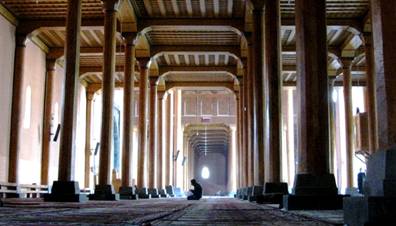
Inside the mosque grounds A single worshiper in a huge mosque
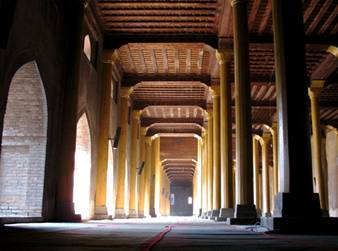
The famous columns, the last one is said to have come for God but no one know which one.Many of the homes in this neighborhood go back hundreds of years. Even though they are very old, and on the outside they seem like they are ready to come down, the neighborhood is very clean. I mean, it is remarkably clean; the streets, the shops, the alley ways, the little nooks and crannies. And the people are dressed very nice. I could not help to notice that their white clothes were brilliantly white.
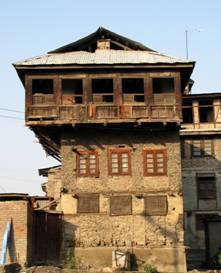
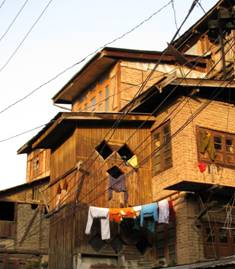
Some of the old homes look like they are ready to fall overAs I walked through the old city, many, many people came up to me and wanted to just talk. With my beard and dark skin, I look Kashmiri; but with my hat, backpack and camera, it was a dead giveaway that I was a foreigner. I had my first tea of many at the home of Umar. There was no one home, so he quickly put on some tea…their home was spotless. You could eat off the floors. Here in Kashmir, they do not have much furniture in their homes, most people sit on foam cushions and when you eat, they place a long narrow table cloth right on the floor and that becomes your table. So you literally eat on the floor.
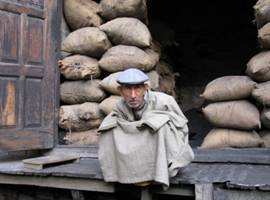
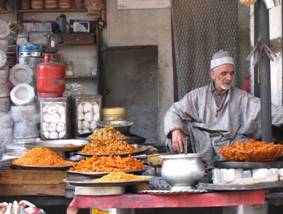
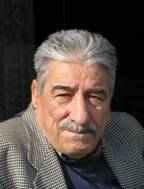
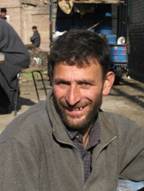
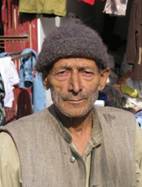
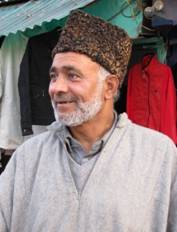
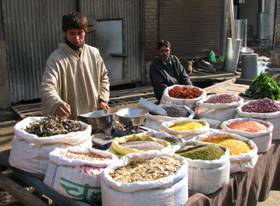
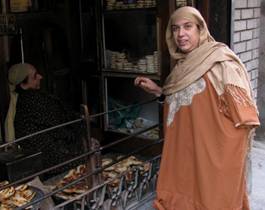
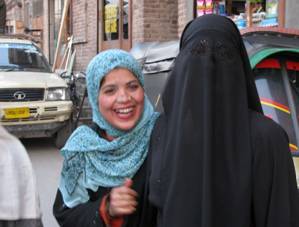
I met many people that welcomed me in their homes, shops and cafes. Their smiles, their greetings, their openness and the care they expressed made me feel as if I was one of their brothers or sons that they had not seen in a while. I started to remember what Rouf, the Sufi had said to me about the openness, about the love and compassion of the Kashmiri Muslims. However, this kind of Islam is completely the opposite of what I had experienced in Saudi Arabia. That walk through the old city took nine hours and it was only about two kilometers. I must have had tea with over 30 people. I ate so much I thought I was going to blow up; kind like when you eat too much at Thanksgiving. These people are truly hospitable, kind, caring, very open and loving. Here are some of the pictures of these beautiful Muslim people.
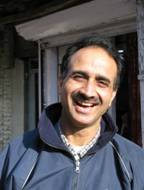
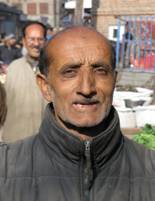
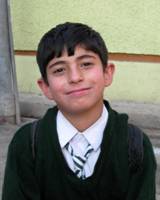
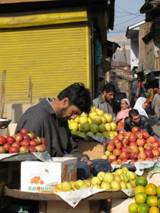
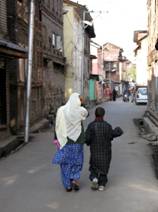
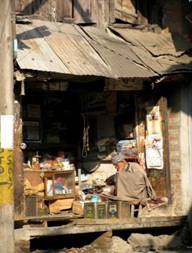
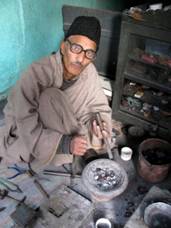
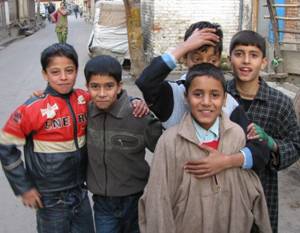
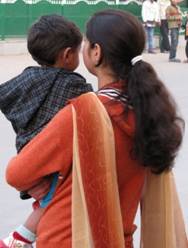
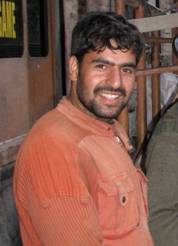
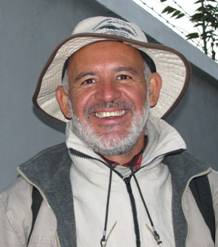
The last foreigner left in Kashmir,
maybe I have become a bit KashmiriI finally got to Shahi Hamdan Mosque. The last time I came here was with Shabir and Hanna; we looked inside the mosque from the door way of the prayer hall because only Muslims are allowed to enter inside of this very holy mosque. I had asked Shabir why they did not allow non-Muslims to enter, he was not sure but he said that maybe it was because this was a very holy mosque but later he wondered about it himself. I had told him that in Mecca, non-Muslims were not allowed to enter the city. He was quiet for a while and then said, “They should let you into any Muslim place if you say these words”. “LA EE LA HA IL LAL LA, MOHAMMAD ROSUE LU LA (SAW), SA LA HU ALYHE WASALAM.” This means, “There is only one God and Mohammad is his prophet.
As I approached the entrance, I thought to myself…”Could I repeat these words and mean it, this is a holy place for Muslims”. I thought about it a while longer and said to myself, “I do believe that there is one God and I do believe that Mohammad is one of his prophets”. I was satisfied that I would be truthful about the words I was about to speak.
So I walked up and I greeted them, “ASA LA MU ALY KUM,” this is also Arabic and it means, “May the Peace of God be with you”. The man at the entrance responded by saying, “WA A LAY KUM SALAM”, which means, may the peace of God also be with you. I think it is a very nice way to greet someone. And by now, I have been in Kashmir for some time and this kind of greeting has become a very normal way for me to greet anyone. So I repeated these words, they looked at me, I repeated these words again, they looked at me again. Even though I look Kashmiri, again with my backpack, hat and camera and I am sure they thought I was just a tourist. One of the older men came up to me, looked at me, smiled and then gave me a cap to cover my head. He then took me by the hand and brought me inside the mosque. He told me this was my home and I could pray or just sit. He also told me that I could take all the pictures I wanted. I couple of people came up to me, greeted me and started to talk to me about where I came from and so on. They brought me tea and some bread. Outside of prayer times the mosques function as community centers. People gather to socialize, eat, and learn about Islam. There is always something going on and many of the activities are for helping those in need.
That was such a wonderful walk. The way that the Kashmiri Muslims have just taken me in as one of the own and shown me the how beautiful Islam can be. It made me realize that the Islam practiced here is not what I witnessed back in Saudi. This is an entire new view on the Islamic way of life. This has caused an incredible mind shift in the way I now view Islam. I will always be thankful and indebted to all of my Kashmiri Muslim brothers.
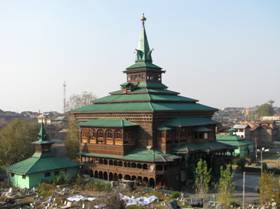
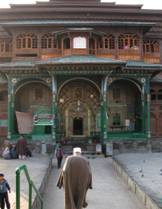
The Holy Mosque of Shahi Hamdan
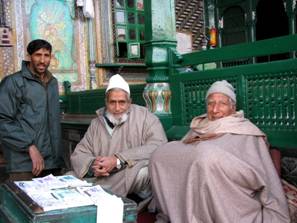
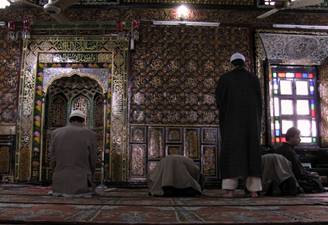
The old men that greeted and welcomed me to their holy mosque Praying inside the mosque