Jose's India Travel Newsletter
K A S H M I R

 Introduction Delhi Leh/Ladakh Kashmir
Kashmir Section 5 Kashmir: Section 1 I Section 2 I Section 3 I Section 4 I Section 5
Shabir Butt and Ibrahim Thulla and his family
From the time we came on board the house boat, Ibrahim, the house boat owner, made sure we were comfortable and he and everyone else helped us with anything we needed. For the first ten days of my stay, Shabir and Hanna were here. Shabir was so proud and happy to take us around his village and city. We went on walks down the boardwalk, on crazy auto rickshaw rides all over the city, visited the Mogul Gardens, the mosques, we did shopping and ate at many restaurants. He even took me to the gold market where I sold some of my old jewelry that I hadn’t worn for years. I brought it to India with me because I knew I could sell it and get top dollar for it. We met some of his friends and I met his family. He really took good care of us. Ibrahim knows Shabir’s father and family and had seen Shabir grow up; actually just about everyone here in the Village of Dal Lake knows each other and each other’s business for that matter. So, Shabir had to be careful not to show signs of affection towards Hanna anywhere around the house boat or in public. It was good that I came along because it looked like Hanna and I were a couple. In Kashmir it is very important that the families meet first and come to some agreement on the future of their sons and daughters, especially when love is in the air. But after they left, I was on my own and Ibrahim and his family then took over from where Shabir and his family left off.
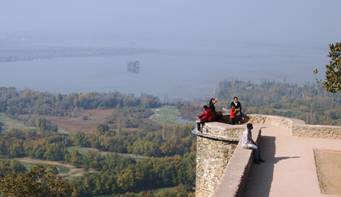
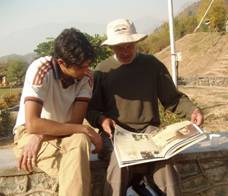
At one of the Mogul Gardens looking down on Dal Lake Shabir and I looking at the book, “The Sufis of Kashmir”
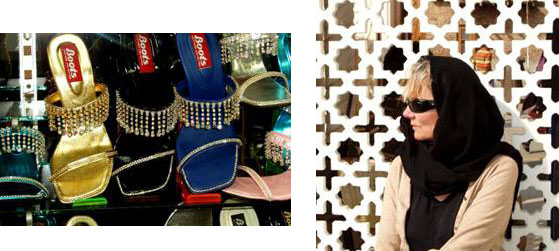
Hanna shopping for fancy shoes at Lal Chowk Hanna at Hazratbal Mosques, over 50,000 people attend Friday prayer
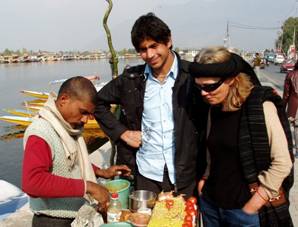
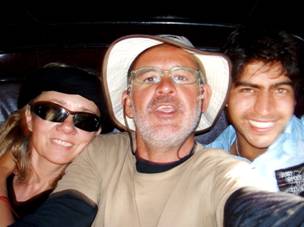
Shabir and Hanna buying some Indian snacks on the Boardwalk On one of our crazy auto rickshaws rides, “Hold on and Smile”
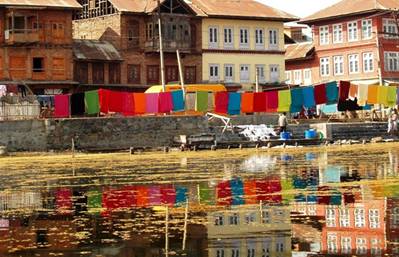
So that’s where our laundry goes?Ibrahim and his family live on an island right next to their house boats. Their island is about 15 by 60 meters (48 by 198 feet). They all work on the house boats to make sure that their guests are comfortable and they have everything they need. After the independence of India in 1947 when the British left, Ibrahim’s father inherited the large boat “Royal Kashmir” from the British owners where he had worked for 18 years. Ibrahim’s father then built “Happy House” and now that his father has died the house boats belong to Ibrahim. They don’t grow any vegetables on their island but they have a few sheep and two small homes.
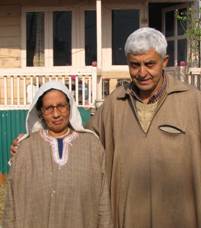
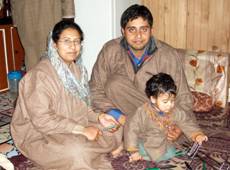
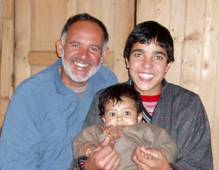
Ibrahim Thulla and his wife Sayida Javid, Sofie and their daughter Aisha Irfan, Aisha and meSayida is Ibrahim’s wife and even though she doesn’t speak English, we communicated just fine and she is as sweet as a button. Ibrahim’s son, Javid, and his daughter-in-law, Sofie, live with them. They have a 15-month old baby girl named Aisha. I like the name because my daughter’s name is Lesha and it almost sounds the same. Irfan works on the house boat and is Ibrahim’s adopted son. When Irfan’s mother died, his father who had worked on Ibrahim’s boats for many years asked him if he could take and raise Irfan. He felt that Irfan would have a more stable family life with them. Fancy is their daughter and she just had a baby. Her baby girl is named Qurat and she is three months old. In Kashmir, when the woman has her baby,she comes back home to her parent’s home to stay and rest anywhere from three to six months. This way they can all be together and the parents and every one that is still at home can participate in taking care of the newborn. Fancy’s husband came by regularly but I always missed him, so we never met.
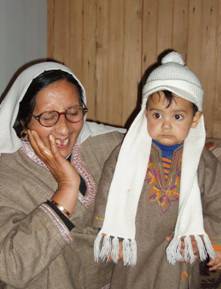
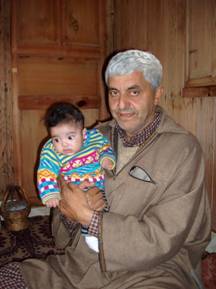
Proud grandmother Sayida and Aisha Grandpa Ibrahim and Qurat
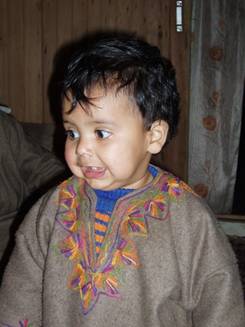
Aisha can be a handful at times Fancy and her daughter Qurat
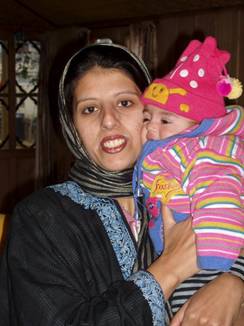
Javid told me that Fancy was really happy to be back home because it was like being on a vacation. Fancy lives in a huge house with her husband. But her husband’s three brothers who are also married, and who also have children, and to top that, their parents all live together. Fancy and another of her sister-in-laws are the youngest; so they have to do all the cooking and cleaning up. It takes Fancy and her sister-in-law an hour and a half just to clean the dishes after a meal. A lot of time is spent in preparing and cooking and cleaning up after each meal…it’s a full-time job. Actually, it is a way of life for the Kashmiris.Irfan, Javid and I became buddies. They would come over to my houseboat to smoke a cigarette so Ibrahim wouldn’t see them. It’s a big taboo to smoke in front of their parents. Javid told me that only one of his friends and one of his cousins knew that he smoked. Late at night we would watch some of the Bollywood movies and Javid and Irfan would translate…what a riot. I watched enough cricket that I learned the game and I even knew a few of the famous player’s names. At times we watched the WWF (World Wrestling Federation) and they wanted me to tell them all about it since it came from America. Well I didn’t know much about the WWF but I blubbered on and it sounded realistic. I recommended that they rent and watch the movie, “The Wrestler”.
One late evening Javid shared this story with me. It was back in 1992 when the militancy was at its height and it was not safe to go in the streets; there was a 5:00pm curfew. They could hear constant gunfire coming from the main boulevard even though their houseboats were about 400 meters away on the lake. They finally decided to move their boats behind the village when several bullets came in through the front door. He said that there was no business and at times they did not even have money for rice.
He said “It was the Indian army who was responsible, how else could the militants from Pakistan come into Kashmir and how could they get guns and bullets”. At the time, there was practically one soldier for every two persons in Kashmir. There were about four million Kashmiris and two million Indian soldiers in Kashmir. He said it is big business for the military “officers”. They let the militants in and sell them the guns and bullets. Those “Bustards”!
Irfan, a really nice kid
Javid is 28 and his wife Sofie is about the same age. Their marriage was a traditionally arranged one. I asked Javid if he was happy and his response was somewhat slow and not what I would call encouraging. But they have a child and as many Kashmiris; their marriage will endure and they will stay together all their lives, in time they will learn to love each other. It is also traditional that the men make the money and the women stay at home and raise the family; this home is no exception. It was nice watching everyone involved in the day-to-day as one large family. There is something beautiful about a child receiving their love and nurturing from a consistent source, day after day.
Irfan was always there to serve my breakfast, clean the house boat and make up my room. Every night he would bring a hot water bottle and place it in my bed. He is a very kind boy, 15, and he would often talk to me about his mother, girls, smoking, drugs, and things he could not talk about with his father Ibrahim. He was really happy I was there and asked my advice and opinions on many things. I was kind of the father figure but the one that you can tell your secrets too. At times I had to chase him out of the house boat because I wanted to go to sleep.
All of them would always make sure that I had plenty of Kashmiri tea and they would always ask me what time I wanted the hot water in the morning. The hot water heater is fueled by wood so they had to get it going each morning. It only took 15-20 minutes to get the water boiling hot and I’m glad they had a big water heater because toward the middle of November, as I mentioned before, I was taking 45 minute showers just to warm up.
One day I asked Ibrahim if I could have the recipe to a vegetable curry they made for me one evening. He asked if I wanted to learn to cook Kashmiri style cooking. I said “sure, why not”. He told me that the only way I was going to learn to cook was to make the dishes myself. From that day forward, Sofie was my cooking teacher and Sayida supervised us, she is the master chef. They made me do everything except clean the dishes; they said that was women’s work.
Sofie called me a bad student because after about seven nights of cooking I still didn’t remember every step. I ended up cooking for the whole family the rest of my stay in Kashmir and there was never a bit left. It was great to cook with fresh meats and organic ingredients; so that great restaurant food Ihave been eating will never come close to this home cooking.
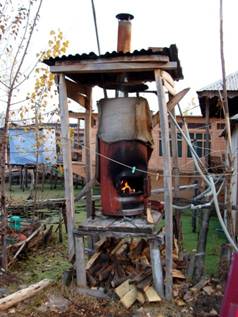
The wood-burning hot water heater, looks are not what they seem, you get lots of hot water!
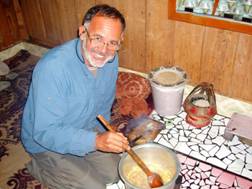
The bad student, but they ate everything My tough teacher Sofie, thank you so much!I remember when I first went over to their home, we all sat in the kitchen and Fancy would breastfeed her baby but turn away from me. After about a month, of going over and cooking and eating and enjoying their company, one day she didn’t turn away anymore; I figured I was had become a part of the family.
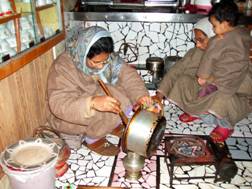
for some delicious Kashmiri recipes, please follow this link
Some of Their Stories
Javid and Raziya
According to Shabir, most of the marriages nowadays are love marriages. He always mentioned the statistic that 75% of marriages are love marriages and not arranged. But most the married men and women I met had arranged marriages.
I remember a conversation I had with another friend name Javid…not Ibrahim's son. Javid in Kashmir is like Jose is in Mexico, a very popular name. . His marriage was also arranged. But he was a lot more positive, actually it’s a beautiful story. Javid was working outside Kashmir when his parents called him to return home because they had chosen a wife for him. In the initial meeting, the two families meet usually without the children’s knowledge. They discuss why they believe their son or daughter would make a good match and have a good future if they married. Not only do they have their children’s best interest at heart, but the parents of the families on both sides become committed to the marriage. In Javid’s case, since his parents selected a wife for him, his family becomes responsible if anything happens to Javid. Javid’s parents and his family will have to take care of their daughter-in-law if their son becomes disabled and cannot work or if he dies. Even if Javid has to leaves the city or even Kashmir for work, they have to take care of her and any children the whole time he is away, just as if she is their own daughter. Getting married is a serious affair. Not only do the kids marry but so do both families. From what I have seen, both families really come together; all the brothers, sisters, cousins, parents, grandparents, great grandparents unite as one very large family.
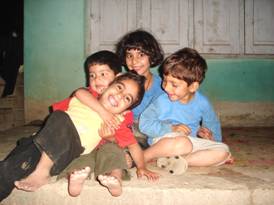
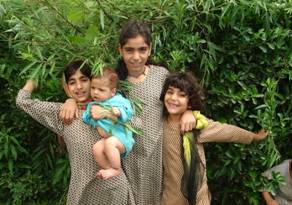
Some of Javid’s cousins
When Javid returned to Kashmir, he and his uncle went to meet his new family. He told me that the night before the meeting he slept wrong and twisted his neck. He could not turn it from side to side; basically it was stuck to the one side. On the way to the his future wife’s home, his uncle greeted a man walking on the opposite side of the street, “ASA LA MU ALY KUM” and the man responded, “WA A LAY KUM SALAM”, Javid, didn’t say anything, not the best thing he told me…but he had his neck stuck to one side. As it turned out, that was his future father-in-law.
At his future wife’s home, Javid told his uncle that he wanted to sit in one of the corners so he could see everyone without having to turn so much. He didn’t want them to think there was something wrong with him because each family checks out the future son or daughter thoroughly. They will check with neighbors, friends, school teaches, religious leaders and so on. They will check to see of the future son has a job and if he is all in good working order. By that he meant that there is nothing wrong, mentally, body, legs and stuff like that. Javid said that sometimes they even follow you to see if you limp or something like that. This is a lif time commitment.
There were many people at the meeting and slowly one by one left the room until just Javid and his future wife remained. Up to this time he didn’t know who in the room was going to be his wife; there had been quite a few gals in the room his age, her sisters, cousins, and best friend. He introduced himself, “My name is Javid and I have 26 years”. She did too. She asked him that if he remembered that they were classmates in high school, 10, 11 and 12 grades. At first Javid didn’t remember, but then it came back to him, his friends and her friends hung out…they both laughed. Even thought they were not close in high school because it was a big school with more than 500 students, Javid thought this was good. Javid told her that he was in agreement with his parent’s decision, and asked her if she was also in agreement with her parent’s decision? He asked her if she was in love with someone else or if she did not want to get married to him. He knew that it was harder for her to reject the marriage because her parents will question her to death, especially if they felt that Javid was a good catch and came from a good family. For him on the other hand, it would be easier to reject the marriage because he felt that he could take the pressure for his parents much easier.
The engagement period lasted three and a half months. And in that period they got to know each other better and better even though Javid was working outside of Kashmir. They would talk on the phone for hours and when he would return, they would each plan a rendezvous to meet away from everyone. Since they were engaged, the police couldn’t do anything if they caught them together. Here in Kashmir, if they were not engaged, they simply cannot date in public, they would have to hide and if they got caught, the police could take them to jail and then call their parents. It is considered a shameful act and an insult to your parents and family if you go behind their backs and date without their approval even if you are crazy in love.
Well as it turns out, a friend of Javid, Nissar, was really in love with a beautiful girl. Nissar was one of those souls that was heads over heels in love and did not know what to do so he turned to Javid for help. Javid went to speak with Nissar’s parents to try to convince them that the girl Nissar was in love with would make a good match for Nissar. Javid told Nissar’s dad that Nissar was so crazy in love and that he was planning of running away with her. He told him that Nissar’s girlfriend was a very good and would make a good wife. Somehow, Javid managed to convince Nissar’s father and he agreed to go and meet the girl’s family. Javid quickly called Nissar’s girlfriend and told her how to act and behave in from of Nissar’s father so he would accept her. When the father went over, her family was waiting for him because they know that Nissar was a very good catch and he came from a very good family. The Kashmiris always use “good” to means, “having a good heart and being a good Muslim”. This would be a wonderful thing for their daughter. She did exactly what Javid had instructed her to do in the presence of Nissar’s father. The meeting was successful and Nissar’s father was so impressed that he asked for her hand in marriage. Even though, Nissar’s girlfriend was illiterate, she had memorized the entire Quran and taught it’s teachings to children as young as three at a private school. While this was a love marriage, and everything turned out good; had Nissar simply run away with his girlfriend, this act would have brought shame upon both families and they would have been disowned! Today Javid is Nissar’s father great fan because his son’s wife has turned out to be such a good wife and the marriage a big success. And Nissar is so grateful to Javid and says to Javid whenever they meet “It is because of you that I am with my wife”.
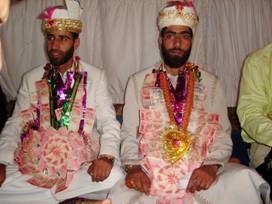

Nissar and his friend on their weeding day, double wedding Javid, middle with his friends Nissar and Ruby after the wedding celebrationAnyhow, getting back to Javid; as time passed, Javid and Raziya, his future wife, got to know each other and fell in love. No sex of course, even though at times some of their rendezvous’ got steamy, they waited until they got married. He told me that they are now really in love and that he loves his wife more than anything in the world. Both sets of parents now take care of his wife and their son when he is away because he is working outside of Kashmir in Dharamshala. It is one big family and everyone takes care of each other. Javid said, “Talking about pressure, you simply don’t even think about divorce”.
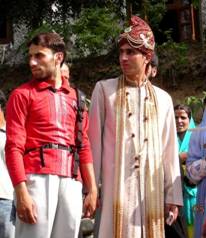
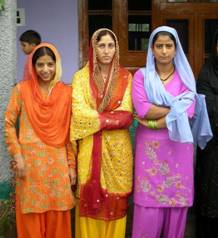
Javid on his wedding day Raziya, Javid’s wife, in yellow, and Javid’s cousins after the wedding, ladies smile pleaseJavid’s Aunts
Javid’s aunties
Javid told me a story about these two aunts and I thought it was so nice that I wanted to share it with you. It is brief but I know that if I dived deeper into it I could learn lots more. These two aunties as Javid calls them got married with two of Javid’s uncles on his father’s side and they lived together in the home behind them. Each couple has four children, so there are a total of ten in the home.
Their husbands are both teachers and when they started their families about 25 years ago each of the husbands earn only 400 rupees each a month. Together, that was about $64.00 USD a month at 1984 exchange rates. Javid said that everyone could not believe how they could make it on so little money. He said his aunties were busy bees and did so many little jobs to earn extra money to help their husbands and to make ends meet. The aunties are talented embroiderers. This is a handicraft Kashmir is known for. They would embroider anything that would make them some money. . Javid said that they would work almost 24 hours a day. You can see some of their work on the clothes they are wearing.
Today, because of these two women, four of their children have graduated from university. The husbands earn a bit more now, around 1,000 rupees each a month. At today’s exchange rate, their combined income is still only about $88.00 USD. However, they have managed to buy more land and have built a better home. Javid told me that he cannot believe how good his cousins have turned out and how grateful they are for everything their parents have sacrificed for them.
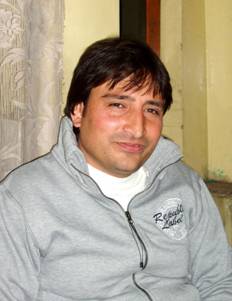
Firdous Shah
Firdous Shah
owner of the Skybiz Cyber CafeFirdous is a soft spoken young man and owner of the Skybiz Cyber Café. I was a regular. This café has the best internet service in town and Firdous advertizes air, bus and train ticketing. I was planning to leave Srinagar by shared jeep to Jammu and on to Delhi by train. The trip to Jammu takes 8-10 hours but the roads are much better Ladakh. The train is comfortable overnight sleeper car. By now, saving wear and tear on my butt is important.
Out of curiosity I asked him if he could check the price of a plane ticket to Delhi. To my surprise the price of the ticket was just a bit less then taking the jeep and then the train and all the other travel expenses, meals hotel…etc. I asked him to book it and he even took a credit card, no problem. I was so impressed by his attentiveness and professional business style that we began to talk about his business. He started the business with one computer and now has 10 stations, all Skype capable. He also offers international calling and is a registered travel agent. The business is very profession but cozy!
The conversation turned from business to him; he told me that all of his brothers and sisters are professionals, doctors and so forth except for him. Because of the militancy uprising that began in 1989 and grew into the total degradation of law and order all over Kashmir, by 1995 there was no one left at the University of Kashmir to administer the final exams to the students. He was a student at the university but for all practical purposes, the school was basically closed and it wasn’t until 1998 that he was able to go and take his final exams. But the professors were so afraid to stay and administer the exams; they just left the exams in a room at the university and left. He said it was not really an exam, more of an open book test. He received a diploma a year later. So he started the business because he needed to find a way to earn some money through all of this. But business and life in general was tough; at times he would stay locked up inside the café because of the rioting in the streets and there were many militants shooting off their guns.
He told me that one evening the rioting got really bad and their father hadn’t returned home. As the hour got later and later, they feared the worst. Around midnight, the three brothers left home to search for him, each one went in a different direction. The following day Firdous and one of his brothers returned only to find that their father was still missing. It wasn’t until the afternoon that their father appeared. He had been taking refuge in a mosque all night and was barely able to make it back home. By that time, the third brother had not returned and again they feared the worst. That evening he returned home; he was also hiding at the mosque. Firdous told me it was one of the worst nights of his life, not knowing and fearing that your father or one of your brothers may be dead.
He told me that most of the militants came from outside of Kashmir and the Kashmiris that jointed them didn’t even know what they were fighting for; but this armed uprising has taken away the last 20 years of his life. He said that even the old men had lost their faith. I remember as he spoke these words, his head lowered and there was quietness in the room. There were some of his friends sitting with us and they also had a look of “why” on their faces. It was difficult to start a new conversation but Firdous crack a smile and said, “We must look forward and move on”.
The Arabica Cafe
As I mentioned previously, I had many conversations mainly with Kashmiris at this great coffee house. It is a bit expensive by Kashmiri standards; a great cappuccino is about 45 rupees. Many were middle class a few rich ones folks but all have suffered one way or another for the past 20 years since the militancy started in 1989. The situation has improved over the past two years and some sort of normalcy has return to Kashmir. Not all our conversations were serious, we discussed everything from politics to beautiful women; anyhow we laughed a lot. But when they spoke to me about the past 20 years, even though I got the feeling that they just couldn’t wait to tell me about it-- especially since I was an outsider-- towards the end of their stories there was a great sadness.
Younis Anjum
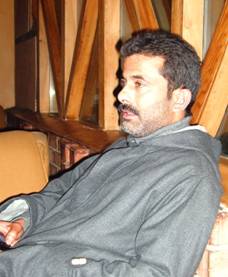
I met up with Younis on several occasions we had many long discussions. Younis has a degree in electronics but now has a pharmaceutical distribution business.
My first conversation with him was about the history of Kashmir over the past two thousand years…yeap, we drank a lot of coffee. I didn’t know much about Kashmir before coming here. Well, I do have a “Kashmir sweater”, one that an old girlfriend gave me, but I wasn’t sure where it came from, only that it’s really soft and warm. Come to find out, the use of the word “Kashmir” was coined by Italian and British textile and clothing manufactures to refer to the products that come from the wool of the Pashmina goats, which is a special breed of goat indigenous to high altitudes of the Himalayas.
Well one thing was clear as I listened to Younis; the Kashmiris have been influenced by so many different rulers, cultures, languages and religions for the past two thousand years. The only thing that seems to be consistent in this culture is change. There are several languages spoken here but one of the earliest Kashmiri languages was Hebrew. It has been claimed by some sources that the Kashmiri people are descendants of the twelve lost tribes of Israel and are originally of Jewish descent.We often spoke about the militancy and the effect it has had on the people, their lives, and their minds. There have been many summits and meeting regarding the resolution of Kashmir but all interested parties have a firm military grip on their claim and are not willing to relinquish it. Pakistan will not give up the northwest part they are occupying, China the northeastern section and India the southern part. The ones caught in the middle of all this is the Kashmiris and they don’t believe anyone anymore. The one thing always say is “It’s a political game they are playing with our lives, our lands, and our culture”.
Younis and I have a common friend, Irfan Hassan, who loves Elvis. I wouldn’t doubt that he has the white Elvis suit in the closet. We also had some great conversations and these are a few books that Irfan recommended, “The Venture of Islam” by Marshall Hodgson; “Eastern Origins of Western Civilizations by John M. Hobson”; and “Ornament of the World” by Maria Rosa Menacol. We may not have all the time in the world but these are masterpieces.
The Jonny Depp of India, Omar LateefOmar Lateef
This is a funny story. Omar Lateef and his brother, Faisal, like many Kashmiris who have left come back to visit family and friends. Omar is a young up-and-coming actor who lives in Madras, now known as Chennai. He has been in various movies. “Poi Solla Porom”, in English, “We are going to Lie” a Tamil comedy was release last year. The others are in the process of being released but he plays a villain in the Bollywood movie ”Bum Bum Bole”. He had a small part in “Palya” and had a larger role in “Madharashapattinam”, a movie about Madras back in the 1940. He caught my attention because of his impersonation of Jonny Depp’s character role of “Caption Jack Sparrow” from the movie, “Pirates of the Caribbean”. What was more impressive is that he looks just like Jonny Depp. Take a look for yourself. I call him, “The Jonny Depp of India”. He is on facebook and you can also Google him. I wish you a lot of luck in the future and if I make down to Madras, we’ll down a few beers. Ladies, I believe he’s single!
Elayne McCabe
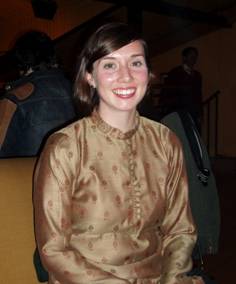
Younis introduced me to Elayne at the Arabica Café and even though she is not Kashmiri, she is doing something I that I believe needs to be brought out on the world stage so people everywhere can have a better understanding about Kashmir.
Elayne McCabe is creating Kashir, a feature-length documentary film that explores the transformation of Kashmiri society from the viewpoint of local artists twenty years after the onset of an armed independence struggle against Indian rule in 1989. The Kashmir Valley is a divided territory situated high in the Himalayan Mountains of South Asia on the contested border between India and Pakistan. Today there are more than half a million Indian security forces controlling the 5 million civilian population. As Kashmiris struggle to make sense of the failure of their violent revolution, they are now pursuing non-violent strategies of protest and resistance, most notably through new forms of artistic cultural production including music, films, paintings, literature, non-fiction graphic novels, poetry, and theatre that focus on the conflict's transformative effect on the Kashmiri community. Taking its name from the Kashmiri word for their homeland, Kashir engages the work of local artists to explore Kashmiri history, culture, and traumatized psyche and provides a nuanced cinematic exploration of the impact of war on art, culture, and identity in a region with extraordinarily rich folk traditions.
Elayne is a filmmaker from Salem, Massachusetts. She graduated from Boston College in 2006 with a degree in East Asian History and Film Studies. In addition to her work in Kashmir, she has lived and worked in Japan, Indonesia, and other parts of India. From February to July 2008, Elayne lived in Srinagar, Kashmir’s largest city, on an Asian Cultural Council Artist fellowship researching the role of local artists in the separatist movement and how artists and filmmakers are engaging the conflict in their creative processes. In addition to exploring contemporary Kashmiri art as a specific lens to view the conflict, Elayne also worked closely with traditional handicraft designers and artisans to develop a film that is visually inspired and informed by Kashmir's brilliant art history. Kashir is her first feature-length documentary.
In the USA
Elayne McCabe
15 Patriot Lane
Salem, MA 01970,
USAIn Kashmir
Malik Sajad
C/o Malik Copper Store
Firdousabad Dobhi Muhalla Lane 2, Batamaloo
Srinagar, Kashmir, India
Mobile in Kashmir: +91 9419076795
Elayne is running out of money to complete this film so I am asking for your financial support to help her finish this very important film. If any of you know any wel- to-do Kashmiris out there who are also interested in getting out the word about Kashmir and who could donate some money for this cause, it would be greatly appreciated. If your company or organization, or even you yourself, could contribute--again, it would be great. We have not set up any direct accounts yet but for the time being; please send your checks in the name of Elayne McCabe to one of the addresses listed on the right.
If you need more information about what Elayne is doing please email her at: elayne.mccabe@gmail.com
Bits and Pieces
There always remain some bits and pieces of stories that are interesting; even though I didn’t get their names or where exactly it happened.
“How My Friend Became a Terrorist”
This occurred somewhere in a village near Pahalgam, about 90 kilometers south of Srinagar; also during the height of the militancy. This a tragic love story about a friend of someone I met. He said to me:
My friend was in love with a girl from a village next to ours. Everyday he would walk or ride his bicycle through the apple orchids to see her. Her village was about 2 kilometers away and it is in a beautiful valley with mountains all around. One day the army noticed his comings and goings and became suspicious. They thought he may be a terrorist and may be planning something. On his way to see her one day, they arrested him and put him in jail. His parents and the village elders came to his rescue and convinced the army officers that his young man was not a terrorist. They let him go but the army kept their eye on him.
Once again, on his way to see his girlfriend, the army picked him up. They took him to his parents’ farm where they beat and tortured him trying to get him to admit he was a terrorist. But there was no admission. The army left but they would come back regularly and take cases and cases of their apples. The army began to make a lot of money by exporting their apples throughout India. On numerous occasions the soldiers would beat them if there were not enough cases of apples picked. They were thieves. When there were no apples left the soldiers burned down their farm.
He fled into the surrounding mountains and joined the real terrorists who were fighting the Indian army. He was trained by these terrorists but was later captured by the Indian army. The army gives you two choices if you are captured. Renounce terrorism and be conscripted into the army or go to jail for years. He decided to join the army but his real motives were to infiltrate and destroy their camp. The army trained him and he was assigned to a special terrorist task force. The day came for him to act. He booby-trapped the weapons and fuel storage stockpiles with bombs. Then sent a message to his terrorist friends to attack the camp and provide cover for his escape. The next day the terrorists came and attacked the camp and he escaped.
When he was crossing the river, he set off the explosives with a detonator and destroyed most of the camp. There wasn’t a piece left where the bombs went off. Soldiers from another camp caught him and shot him on the spot.
The people of his village were happy for the damage he had inflicted on the army. Many of them had been victims of horrific acts by the army. After that incident many of these acts of torture and abuses by the Indian army were uncovered. The army was forced to leave many of the villages around Pahalgam..There are countless other stories like this, not just in Kashmir but all over the world. May all those affected by these tragic conflicts find peace and tranquility their hearts and minds.
Back to Delhi
I met and made friends with so many Kashmiris. Before leaving, it took me three days of going around to say my goodbyes. I couldn’t just say bye, I had to sit down for one last tea and something to eat. On the way to the airport, I felt I was leaving home. A part of me is a bit Kashmiri and we will be in each other’s hearts for a long time.
I arrived in Delhi but at the airport in Srinagar, there were eight security checks. I have never seen so much security anywhere and I have been in several major armed conflicts and crises throughout the Middle East. But we all got in line and it didn’t seem to bother anyone. A very nice thing happened. There was a group of Kashmiris going to the “Hajj” in Mecca. The “Hajj” or pilgrimage is an important milestone in a Muslim’s life. While not everyone is able to make this pilgrimage, if you can go at least once time in your lifetime, you should. One of the men recognized me from my walk between Jamia Masjid mosque and Shahi Hamdan in the old city. He came up to me extended his hand and smiled. Even though we could not communicate with words, we shared tea. It was nice to see these old men and along with some of their wives full of joy in their brilliantly white clothes. They seemed content as though they lives were now complete. They were on their pilgrimage to Mecca. I do not believe they have lost their faith. Here are a few of their pictures.
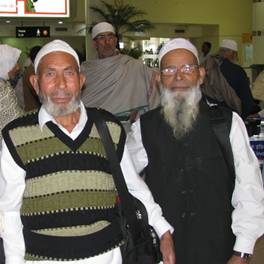
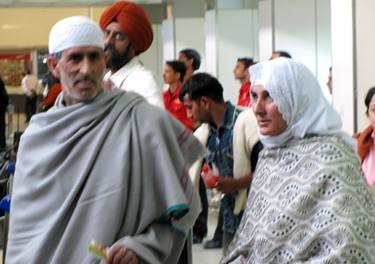
Kashmir pilgrims at the airport on the way to Mecca to the “Hajj”
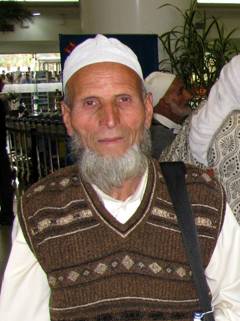
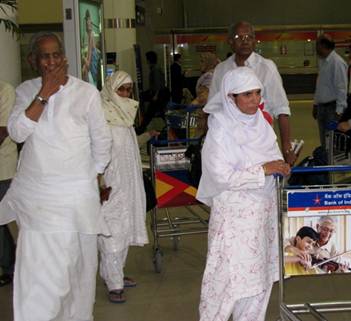
This man recognized me from my walk through the old city Their clothes are brilliantly white